
Why Math Puzzles Stop the Snooze-Button Cycle
Discover the neuroscience behind cognitive alarm dismissals. Simple mental math activates your executive function and halts automatic snooze behavior.
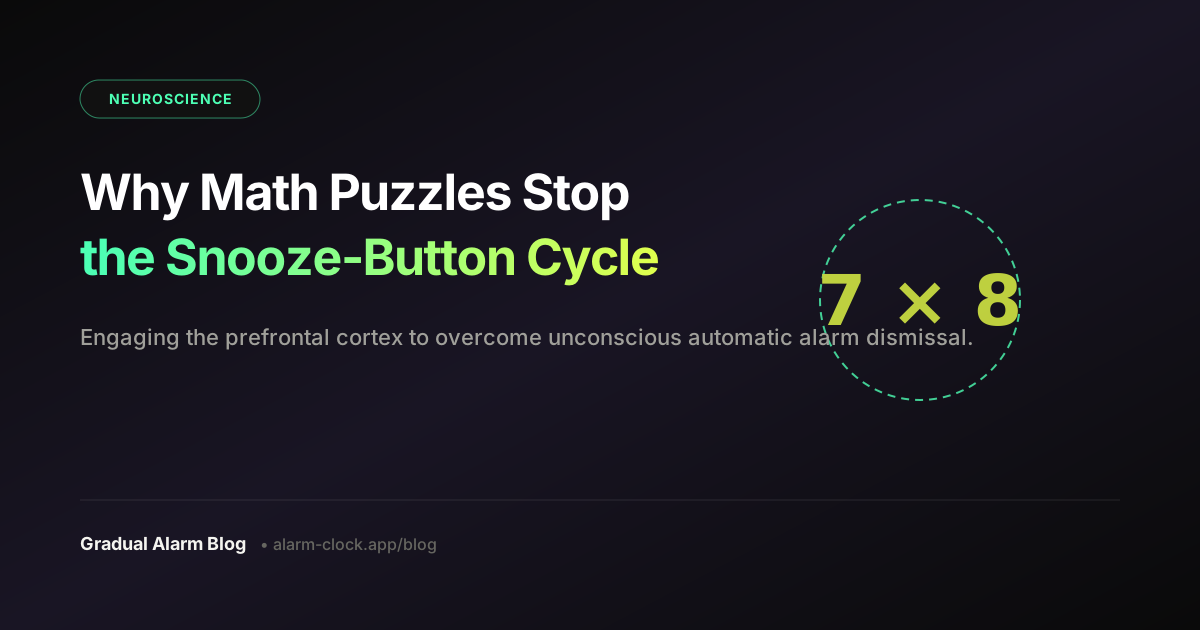
We have all experienced “zombie mode”: the alarm goes off, your hand blindly swipes across your phone screen to silence it, and 45 minutes later you awaken in a panic, completely unaware of having touched the device.
This automatic behavior is not laziness-it is an evolutionary quirk of human motor memory. Here is why solving a simple math puzzle stops the snooze reflex in its tracks.
The Problem of Motor Memory in Semi-Conscious States
When you perform the same action hundreds of times-such as tapping or swiping a large red button on your bedside screen-the basal ganglia and motor cortex automate the movement.
When your alarm rings in the morning:
- The subcortical emotional brain and motor loops wake up first.
- The prefrontal cortex (PFC)-the seat of executive function, willpower, and long-term planning-remains dormant.
- Your hand executes the swipe unconsciously, silencing the alarm before your conscious mind has even evaluated the consequences of being late.
The Cognitive Pivot: Engaging the Prefrontal Cortex
A cognitive challenge acts as an neurological circuit breaker. When Gradual Alarm presents an arithmetic puzzle (such as 17 + 28 or 6 × 9):
- Inhibition of Automatic Motor Routines: The brain cannot rely on pre-programmed muscle memory to tap the answer.
- Prefrontal Cortex Activation: Mental arithmetic requires working memory, numerical representation (parietal lobes), and executive decision-making (dorsolateral PFC).
- Restoration of Awareness: By the time you calculate the answer and enter the solution, full conscious awareness has booted up.
Cognitive Balance: Why Simple Math is Best
Crucially, the goal of a morning puzzle is not to cause frustration or anxiety. Complex calculus or cryptic riddles produce irritation and stress hormones, triggering anger instead of alertness.
A straightforward mental arithmetic problem offers the exact cognitive threshold required:
- Easy enough to solve within 5 to 10 seconds.
- Engaging enough to prevent accidental dismissals.
- Satisfying to complete, providing a microscopic dose of morning accomplishment.
Pairing progressive 4-stage volume alarms with a gentle math dismissal provides the optimal combination of auditory comfort and cognitive clarity.
Wake up peacefully tomorrow morning.
Download Gradual Alarm and replace jarring panic alarms with progressive 4-stage volume, math puzzle dismissals, and bedtime reminders.
More from the Blog
View all (5) → Sleep Science
 10 Health Benefits of Waking Up with a Clear Mind
Discover how waking up gradually without harsh alarms eliminates morning cortisol spikes, boosts mental focus, and transforms your daily well-being.
 Sleep Science
 How 4-Stage Alarms Prevent Sleep Inertia
Learn how breaking your wake-up window into four progressive volume stages guides your brain from deep sleep to alert consciousness without grogginess.
 Sleep Hygiene
 The Ultimate Guide to Optimizing Bedtime Routines
How setting gentle bedtime reminders, reducing evening sensory inputs, and honoring your circadian rhythm guarantees effortless morning wakefulness.